Help! Where’s the good news in Europe?
Tired of the media’s daily output of economic gloom with the light at the end of the tunnel ebbing further away? Courage! As they might say en français – please read on.
First, let’s look at the basic facts. We’re told the EU represents conservatively about 40% of the UK’s trade and that the EU’s public spending constitutes nearly 20% of its GDP. Somewhere in there is a hidden figure showing not only how much of that 40% is made up of public spending exports but also the potential to further develop this market.
If you’re tuned into the ticker tape despondency that the news media dish up every second of every minute, you would think this is the last place to find any glimmer of hope given that not only does Europe seem a busted flush but also that the austerity school is still in the ascendency, driving for huge cuts in public spending in many countries. This however is only part of the story in Europe’s complex and disparate economic landscape with tantalising areas of growth in some countries.
These countries represent not only half of the OJEU’s tender volume but also 44% of its GDP, counterbalancing the shrinkage elsewhere in the previous quarter.
With the exception of Greece, many countries showed positive signs of growth, i.e. not unsustainable public tendering growth with tailspin GDP contraction, but underpinned with GDP growth too.
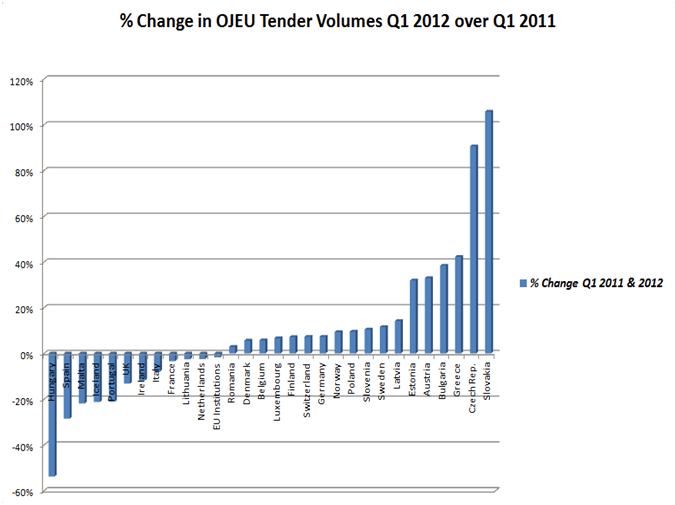
The Hellenics seemingly spat out their bitter medicine whilst Matron Merkel’s back was turned, counter-intuitively defying the laws of Economics (not Politics!) by increasing the volume (value unknown) of tenders published in the last quarter compared with the same period last year by a staggering 41%. By comparison, the European average was 2% and for the UK -13%, yes minus 13% (see graph below). Using an appropriate Greek word, it is a heroic achievement by anyone’s standards.
So now for the potentially good news… (Cue Alan Freeman Hit Parade theme music!)
Northern Exposure
The Nordics with the exception of Iceland represent not only 9% of Europe’s GDP but also tendering activity and combined with GDP growth across the region at a conservative 1% should not be dismissed. English is commonly spoken and Norway, a member of the European Economic Area is an active participant in OJEU tendering with output comparable to the Netherlands. Uniquely in Europe and probably the world, their public savings exceed their public debts by 160% according to the IMF (i.e. they have lots of money!), and they publish all their tenders in English. One of the ironies of not being in the EU but the EEA is that Norwegian isn’t an official EU language and English is their default tendering language.
New Europe
It’s the EU’s relative neophytes who, using Donald Rumsfeld’s (remember him?) post 9/11 emotive polemics are outpacing ‘old Europe’. Estonia, Latvia, Poland, Slovenia, the Czech Republic, Slovakia and even in the wild east Bulgaria and Romania. Collectively they may only represent 7% of Europe’s GDP, but they are all growing economies (Latvia & Estonia 3% & Romania Bulgaria & the Czech Republic 2%).
The increase in tendering activity between these two Q1 periods was high in Estonia 32% and Bulgaria 38% but most notable were the Czech Republic and Slovakia where growth doubled (see chart) compared with the same quarter in 2011 and supported with GDP growth.
At the moment these are only tasters with maybe some statistical aberrations, but they cannot all be dismissed and for the discerning bidder, looking beyond these shores, need to be taken note of. We will return to this area in future blogs.
The EU institutions (e.g. the Commission, European Development Fund etc.) are included in the comparison chart below separately because with its own budgets, they accounted for 1.4% of all OJEU procurement activity last year, higher than 12 of the studied countries.